
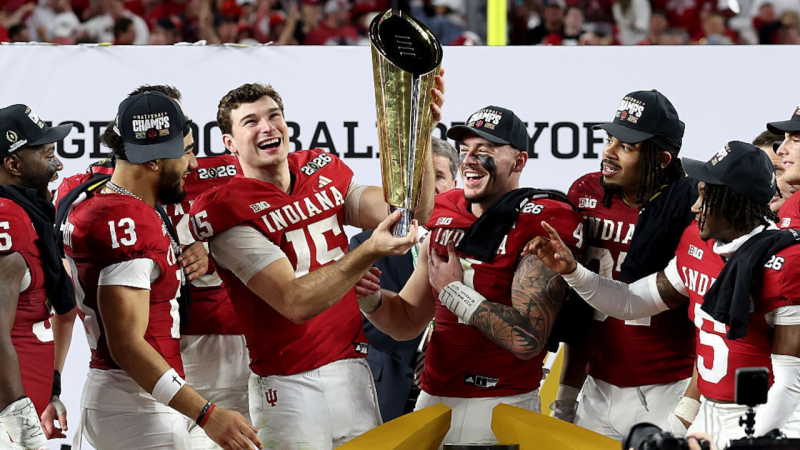
Now, it’s fair to say the NCAA Division doesn’t exactly need tips on how to earn money; it’s one of the richest sports leagues on the planet. However, that doesn’t mean there isn’t further room for optimising that revenue and those profits further.
Around the world, many other huge sporting leagues are doing things a little differently, and the NCAA can look to those to further maximise revenue and profits over the coming years.
The English Premier League, the top-flight soccer league in the country, and arguably the world, is a great example of a league working well and where the Collegiate Athletic Association could take tactics to build globally. But how could it best utilise the Premier League’s playbook?
We look at six lessons that the association could learn from and adopt as part of their commercial strategy moving forward…
Treat global audiences as primary markets, not secondary ones
One of the great strengths of the Premier League is its global appeal. It’s a huge worldwide product; its broadcasting rights now generate more internationally than domestic UK deals.
That’s because the league has worked hard to partner with clubs and institutions in other countries, it's tailored kick-off times to become friendlier to overseas viewers, and they’re marketing in specific areas, backed up by preseason tours.
Unlike the Football Bowl and NFL, which are still very US-focused despite the International Series, it treats fans in the likes of Asia, Africa and North America as core constituents, not secondary, distant viewers.
Of course, college football is making progress with this, but taking some of the ways that the Premier League is approaching foreign markets could really help revolutionise the division abroad, not just for the odd game but throughout the regular season and playoffs.

Embrace the gambling industry as an integrated revenue partner
Speaking of embracing partnerships, one thing the college football sector is starting to do more of, but not quite on the same level as the Premier League and other soccer leagues across Europe, is teaming up with gambling partners.
More and more gambling-based businesses are entering the market, ranging from low deposits to high stakes to big rewards and more. They all present an opportunity, particularly among the bigger brands. Every Premier League club has gambling partners, pitch-side advertising deals and broadcast integrations, while the vast majority have either a sportsbook or casino sponsor on their jersey too.
College football is at the very start of its relationship with the gambling sector. It’s undoubtedly seen its worth, so it’s more about continuing to embrace it, push boundaries and seek out as much worth as possible without affecting fan experience.
The NCAA prohibits sportsbooks from sponsoring championship events. However, conferences, media partners and universities like Colorado, LSU, and Maryland frequently accept sponsorships, advertisements, and data-sharing deals from several different social casinos USA-based and sportsbook companies.
Build club (franchise) brands as global lifestyle products
For Premier League clubs, monetising goes far beyond matchday and broadcasting rights. They sell merch globally, release tailored digital content all year round, and even collaborate with some of the biggest fashion brands around.
It is easier for Premier League clubs due to the diversity of its players. Language barriers become less of a thing, and most teams have at least one player who is relatable to a country or continent. For example, Mo Salah at Liverpool is worshipped by those in Egypt and the rest of Africa.
Manchester United, Liverpool, Arsenal, Chelsea and Manchester City have all become these huge powerhouses, with the latter even collaborating with the hugely popular CP Company of late.
NFL and NCAA franchises are still reliant on league-wide branding and seasonal peaks, but actually looking at the Premier League could encourage more teams to individualise their stories, pursue more partnerships and increase a fan’s lifetime value to the franchise.
Monetise media rights with flexibility and fragmentation
At present, both the NFL and NCAA are prioritising long-term, all-encompassing broadcast deals to ensure financial stability. Which is a tactic that works. However, the league may also want to take a look towards the Premier League, which does things slightly differently. The Premier League is far more flexible, with games split across broadcasters domestically and internationally, which is driving competition and premium pricing.
Short-term deals, highlights packages and shoulder programming are monetised separately, with the league having so much they can sell off to the highest bidder. For example, Indiana, could publish a documentary following their success of winning the National Championships. Internationally, especially, this could really be a game-changer. It is something that is improving with American Sports, with landmark deals with the likes of Netflix, but there is room for landing more opportunities like this.
Leverage data and fan analytics more commercially
Premier League clubs and the league itself increasingly use data to personalise fan engagement, pricing and sponsorship delivery. From dynamic ticket pricing to targeted digital advertising, data informs almost every commercial decision. Sponsors value this precision because it improves measurable return on investment.
College football collects vast amounts of data, but could push further in monetisation. Learning from the Premier League would mean offering sponsors deeper audience insights, personalised activations and outcome-based commercial packages. Data-driven storytelling, such as interactive statistics, fantasy integration and predictive content, can also enhance fan engagement while creating new advertising inventory.
Accept regulatory pressure as a catalyst for innovation
Lastly, the Premier League operates in one of the most heavily regulated sports-commercial environments in the world. That’s especially the case when it comes to broadcasting, sponsorship and gambling. But rather than this being a sticking point, they’ve used it to force innovation, being more creative with sponsorship formats, as well as finding ways to further diverse revenue streams.
In American sports, it has often felt like regulation is more of a constraint rather than a means of seeking opportunities around it. Learning from the Premier League would allow them to anticipate regulatory changes and adapt and react, rather than everything stalling. It would also encourage many brands, particularly in sectors like gambling, to be more inclined to invest long-term.
A different sport, a transferable mindset
So, while the NFL and its feeder system, the NCAA, are doing just fine in terms of their revenue. In fact, more than just fine. There are certainly areas in which it could look to further improve global reach, boost funds from broadcasting and diversify sponsorship deals to generate even more income.
The best thing it can do is look at the Premier League’s adaptable mindset and start to utilise this more. It would undoubtedly help the sport continue to grow over the coming years, but also become even more of a hit on foreign soil, something that we know the league is desperate to do.
